
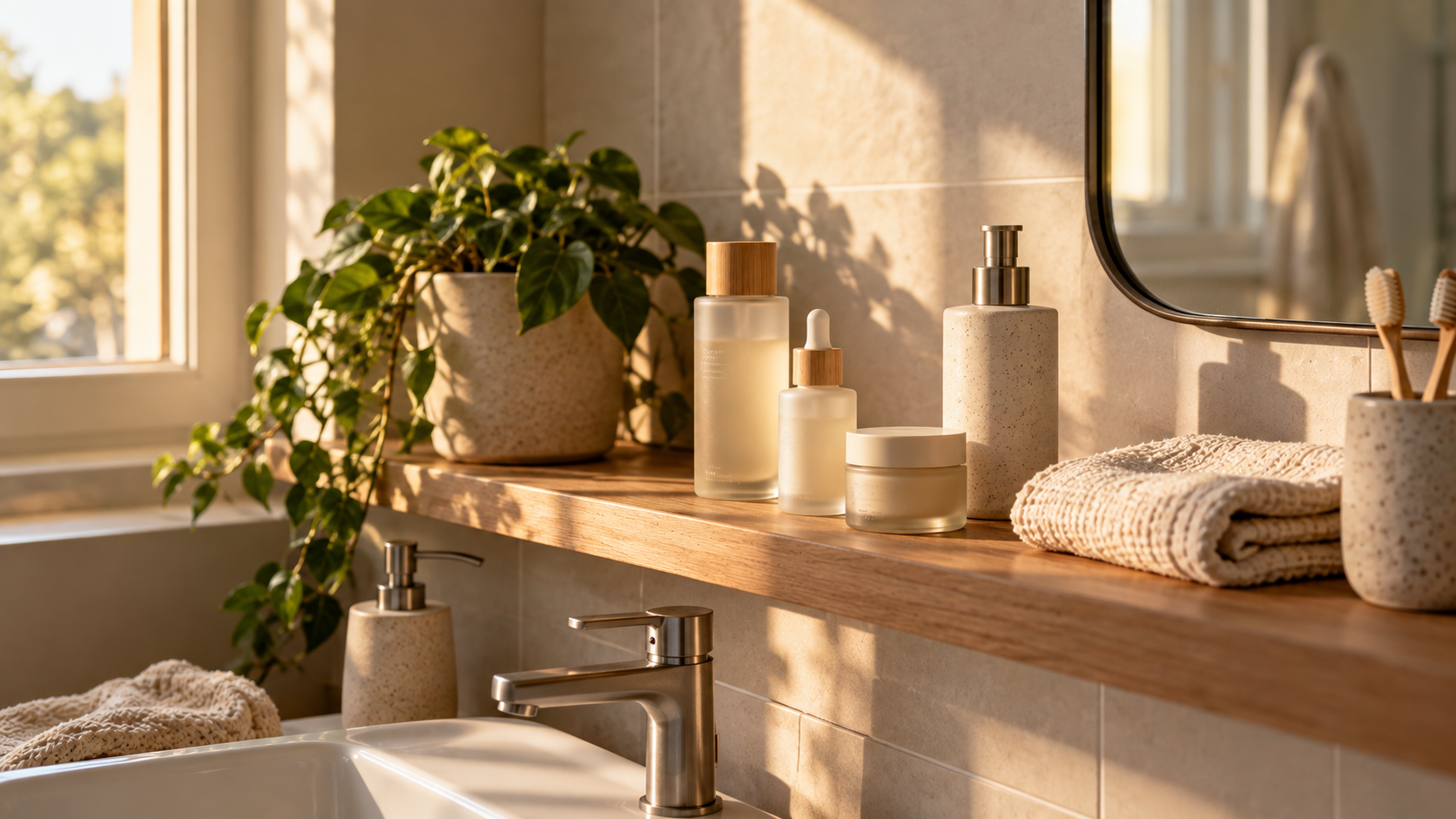
My evening skincare routine is boring and I like it that way. A good wash gel, a glycerin cream for moisture, and a retinal cream every two or three nights. In the morning, sunscreen on my face and décolleté, every single day without exception.
What I cannot tell you is that my skin looks visibly different after a bad night. I have never noticed that. Which is exactly why I wanted to look at what the research says, rather than trusting my own impression of a face I see every day in the same bathroom mirror.
The honest answer to how sleep and skin actually relate turned out to be more interesting than either “beauty sleep is a myth” or the version the skincare industry sells.
What To Expect
What the Main Study on Sleep and Skin Found
The most cited research here is a 2015 study published in Clinical and Experimental Dermatology by Oyetakin-White and colleagues at University Hospitals Case Medical Center. Sixty women were sorted into good sleepers, meaning seven to nine hours with a healthy sleep quality score, and poor sleepers, meaning five hours or less with a poor score.
The findings were fairly consistent. Poor sleepers showed higher transepidermal water loss at baseline, which is the measure of how much moisture passively escapes through the skin and the standard way of assessing barrier function.
Good sleepers had 30 percent greater barrier recovery 72 hours after the barrier was deliberately disrupted. After exposure to simulated sunlight, good sleepers recovered from redness significantly faster. And on a validated skin ageing scale, good sleepers scored lower for intrinsic ageing signs like fine lines and reduced elasticity.
They also rated their own appearance more positively, which is either a real effect or a very human one.
The Caveats That Matter
I want to name these, because this study gets quoted constantly without them.
It was commissioned by Estée Lauder. That does not make the findings wrong, and it was published in a peer-reviewed dermatology journal, but a cosmetics company funding research that supports selling night creams is a conflict worth knowing about.
It also included 60 women, all Caucasian, in a cross-sectional design. That tells you poor sleep and worse skin measures occur together. It does not prove one causes the other. People sleeping five hours a night tend to differ in other ways too.
So the reasonable reading is this. There is a real, measurable association between sleep quality and skin barrier function, supported by a plausible mechanism. It is not the dramatic transformation implied by the phrase “beauty sleep.”
Why Sleep and Skin Are Linked at All
The association makes biological sense, which is part of why I find it credible despite the funding.
Growth hormone is released in pulses during slow wave sleep, the deepest stage. It drives tissue repair and cell turnover throughout the body, and skin is no exception. Cut deep sleep short and you cut into that window.
Your skin also runs its own circadian rhythm. Barrier permeability, water loss and repair activity all shift across the day rather than staying constant, with repair processes weighted toward night. That is genuinely why retinoids are recommended in the evening, beyond the fact that they break down in sunlight.
And cortisol sits in the middle of it. Poor sleep keeps cortisol elevated when it should be dropping, and sustained cortisol drives inflammation and interferes with collagen. I went into that rhythm in more detail in the cortisol post, and it is the same mechanism showing up in a different tissue.
The Thing That Matters More Than Any of This
Here is the part I did not expect to be writing in a sleep blog.
Solar radiation is estimated to account for up to 80 percent of the visible signs of skin ageing. Everything else, sleep included, competes for the remaining slice.
So if you are choosing where to put your effort, daily sunscreen beats an optimised sleep routine for how your skin looks in ten years. Not because sleep does nothing, but because the numbers are not close. I use a daily facial SPF on my face and décolleté every morning regardless of weather or season, and living in Cyprus that is less optional than it might be elsewhere.
Sleep is worth protecting for a long list of reasons. Your skin is a minor one on that list.
What My Routine Actually Looks Like
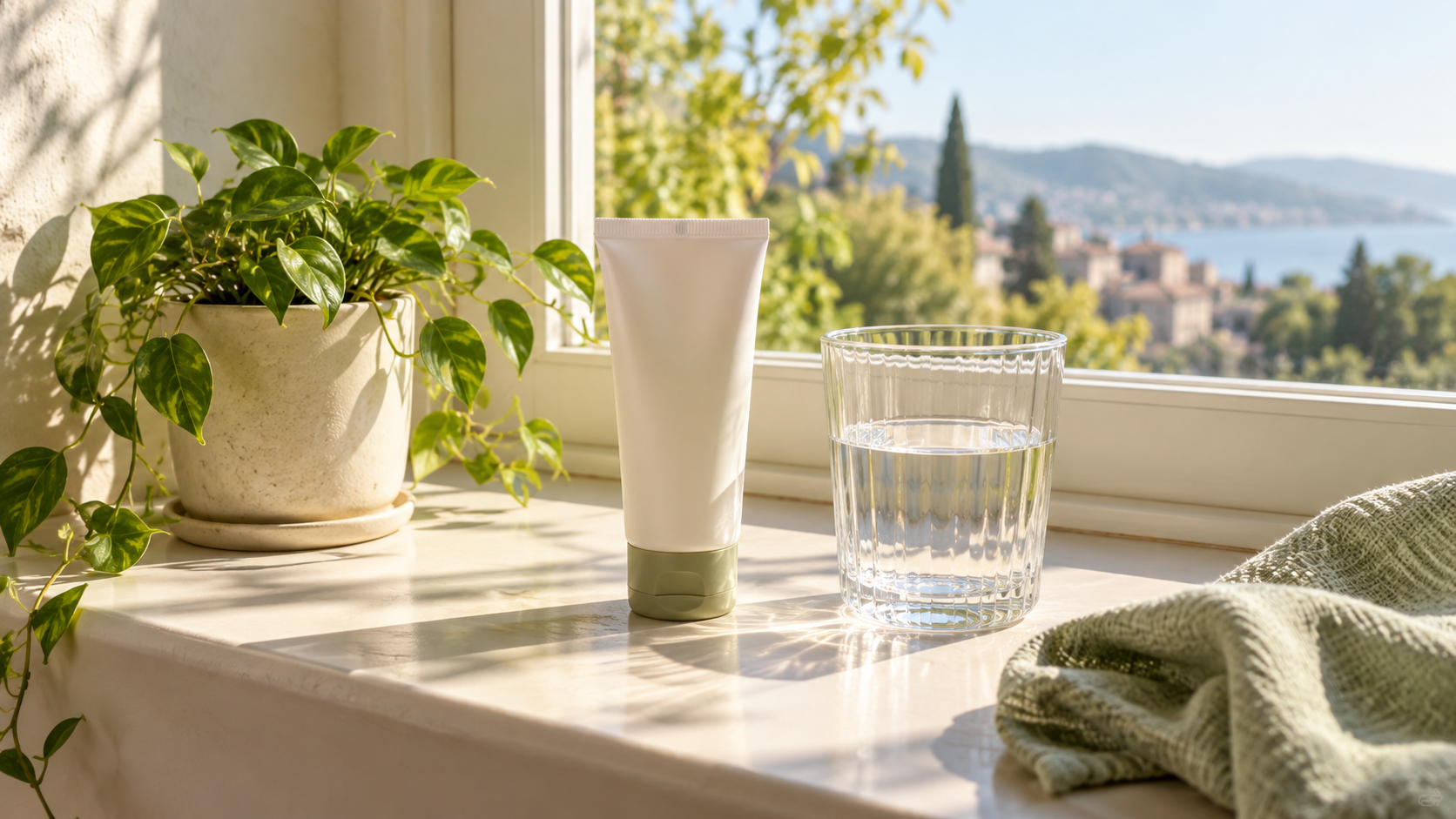
Since the trend right now is body and skincare routines, here is mine, with the honest caveat that it is unremarkable and that is the point. Nothing in it is designed around sleep and skin specifically. It just happens to fit what the research found.
Evening cleanse. A CeraVe wash gel, every night. Nothing complicated. Getting sunscreen and the day off the skin is most of what a cleanser needs to do.
Retinal, two to three nights a week. Retinoids have the strongest evidence base of any topical ingredient for fine lines and texture, and they are used at night partly because they degrade in UV light. Two to three times weekly is a pace my skin tolerates without irritation. Starting slower than you think you need to is the advice I would give anyone beginning.
Glycerin cream every night. Glycerin is a humectant, meaning it draws water into the upper layers of skin. Given the barrier and water loss findings above, a moisturiser doing that job nightly is a sensible pairing with sleep rather than a substitute for it.
SPF every morning. The one non-negotiable, and the one with the strongest evidence behind it.
That is the whole routine. Four steps, nothing layered, nothing expensive.
Frequently Asked Questions
Does lack of sleep really age your skin?
There is a measurable association. Poor sleepers in the main study showed higher water loss through the skin, slower barrier recovery and higher intrinsic ageing scores. It is an association rather than proof of cause, and the effect is modest compared to sun exposure.
How many hours of sleep does your skin need?
The research compared seven to nine hours against five or fewer. There is no specific “skin number” beyond the general adult range, and chasing an exact figure is less useful than getting consistently into that range.
Is beauty sleep a real thing or marketing?
Somewhere in between. The mechanism is real, involving growth hormone in deep sleep and the skin’s own circadian repair cycle. The marketing overstates how much difference it makes relative to sun protection and genetics.
Does a silk pillowcase help?
The evidence is thin. The reasoning is that less friction means less creasing and less moisture drawn out of skin and hair overnight, which is plausible but not well studied. I do not use one, so I cannot tell you anything useful from experience.
Should I change my skincare based on how I slept?
No. Consistency beats reactive adjustment with skincare, particularly with retinoids where the benefit comes from regular use over months. Sleep well because sleep matters. Keep the routine steady either way.
The Bottom Line
Sleep and skin are genuinely connected. Deep sleep is when growth hormone drives repair, the skin runs its own overnight repair rhythm, and the research shows poor sleepers with weaker barrier function and slower recovery from damage.
It is also not the biggest lever. Sun exposure accounts for most visible ageing, which means sunscreen every morning does more for your skin than any amount of optimised sleep.
I still have never noticed a link between sleep and skin in my own mirror after a bad night. The measurements say something is happening anyway. Both of those things can be true.
Do you notice a difference in your skin after a bad night, or is it invisible to you too? I would genuinely like to know!

Leave a Reply