
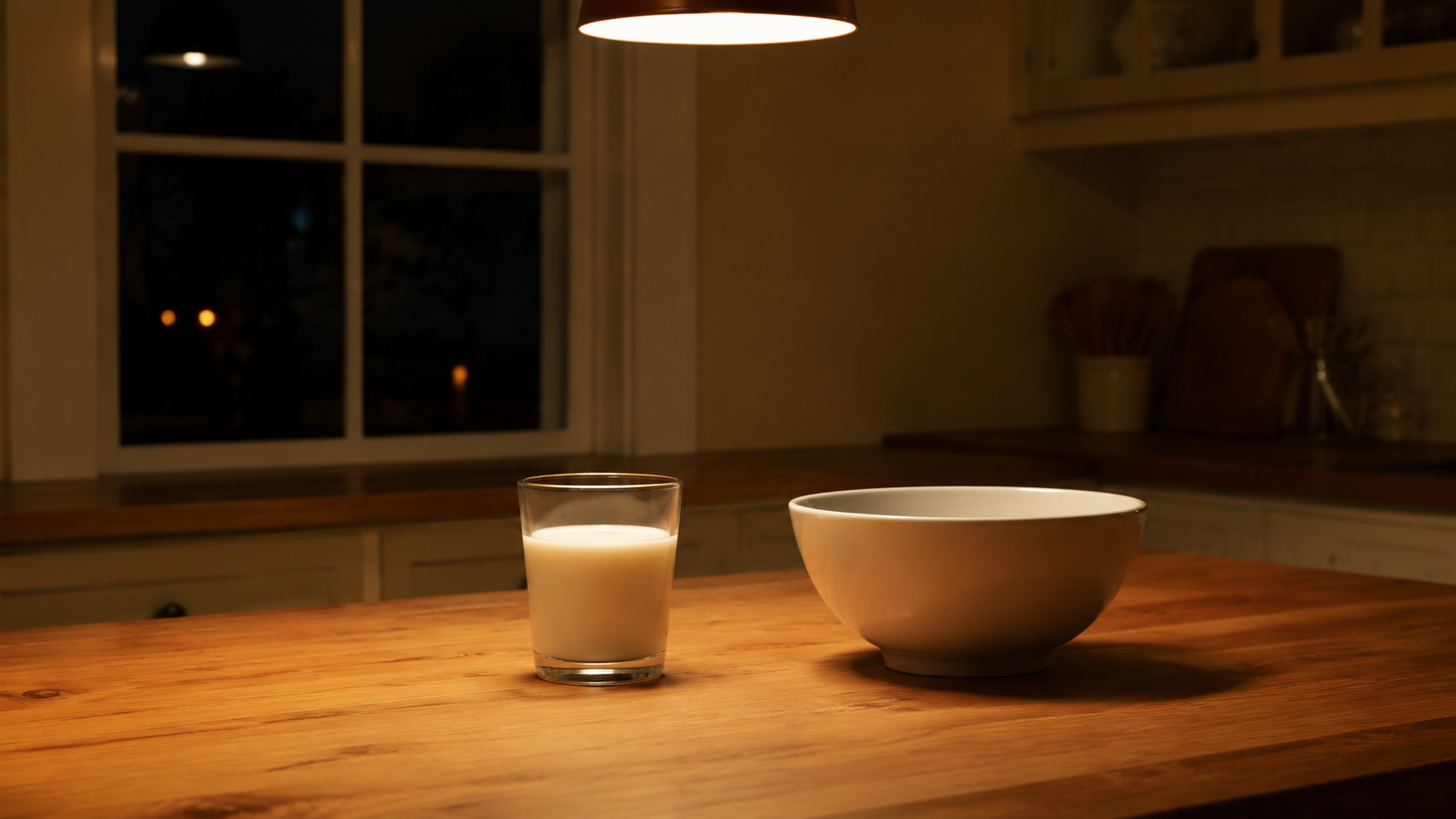
Is dairy before bed bad for sleep? A glass of warm milk is probably the oldest sleep tip there is. Someone’s grandmother said it, and it has been passed along ever since without anyone really checking.
I went looking for the evidence expecting to find a solid explanation. What I found instead was a much messier picture, and one honest admission from a source I did not expect it from.
Table of Contents
The Tryptophan Story Is Weaker Than It Sounds
The usual explanation for why dairy before bed supposedly works goes like this. Milk contains tryptophan, tryptophan becomes serotonin, serotonin becomes melatonin, therefore milk makes you sleepy.
The chain is real. The amounts are the problem. Milk contains roughly 0.042 grams of tryptophan per 100 grams, which is a small quantity, and several foods contain considerably more.
There is one interesting exception worth knowing about. Alpha-lactalbumin, a specific protein in milk, contains the highest level of tryptophan among commonly consumed foods, and small preliminary studies suggest that consuming it before bed may support sleep quality. But the amounts used in those studies may exceed what regular milk naturally contains.
What the Reviews Actually Concluded
Here is the part I found most telling.
A 2020 systematic review covering 14 studies and more than 10,000 participants, summarised by Dairy Nutrition Canada, found small favourable associations between dairy products and sleep quality, including sleep efficiency, duration and how long it took people to fall asleep. But most of those results came from dairy that had been enriched with tryptophan or other compounds, not from ordinary milk.
That same source, which has no incentive to undersell milk, states plainly that evidence on the impact of regular milk on sleep is scarce and that no recommendations can be made from it. Coming from an industry body, that is about as close to a straight answer on dairy before bed as you will find.
A newer systematic review and meta-analysis published in 2025 reached a similar place. Milk and dairy contain compounds with genuine biological plausibility, including tryptophan and melatonin, but human results remain mixed and the mechanism is still unclear. An earlier systematic review covering studies in toddlers, children, adults and older adults concluded much the same, with results varying considerably depending on the population and study design.
So the honest summary is this. The warm milk ritual probably works for a lot of people. Just not necessarily because of the milk.

The Ritual Might Be Doing More Than the Milk
This is not a dismissal of dairy before bed. A warm drink an hour before bed is a genuine wind-down cue. It slows you down, it signals the end of the day, and for many people it carries an association with being cared for in childhood.
Sleep responds strongly to consistent pre-bed signals, which I wrote about in the evening routine post. A ritual that reliably tells your body the day is over is doing real work, regardless of what is in the cup.
When Dairy Before Bed Genuinely Backfires
Here is where dairy can actively disrupt sleep, and it has nothing to do with tryptophan.
If You Are Lactose Intolerant
Undigested lactose ferments in the gut and produces bloating, cramping and gas. Having that happen in the hours you are trying to fall asleep is an obvious problem, and mild intolerance often goes unrecognised because people do not connect a 2am wake-up to what they drank at 10pm.
If You Have IBS or a Dairy Sensitivity
Dairy is a common trigger, and digestive discomfort overnight fragments sleep in the same way any physical discomfort does. If you already know your gut is reactive, dairy before bed is one of the easier things to test by removing it for two weeks.
If the Portion Is Large or Late
A heavy dairy-based snack close to bed is still a heavy snack close to bed. Digestion keeps core body temperature elevated at exactly the point your body is trying to cool down, which I covered in more detail in why you get hot when you sleep.
The pattern worth noticing: when dairy before bed causes a problem, it is rarely the dairy itself. It is what your particular gut does with it.
How Much Dairy Before Bed, and How Late
The question I kept coming back to was not whether dairy before bed is good or bad, but how much of it and at what hour. Those two variables seem to decide almost everything.
On timing, the useful window is roughly two hours. Digestion raises core body temperature at the exact point your body is trying to lower it for sleep, so a drink at nine feels very different from the same drink at eleven. If I am going to have anything dairy in the evening, I want it finished well before I am actually trying to fall asleep.
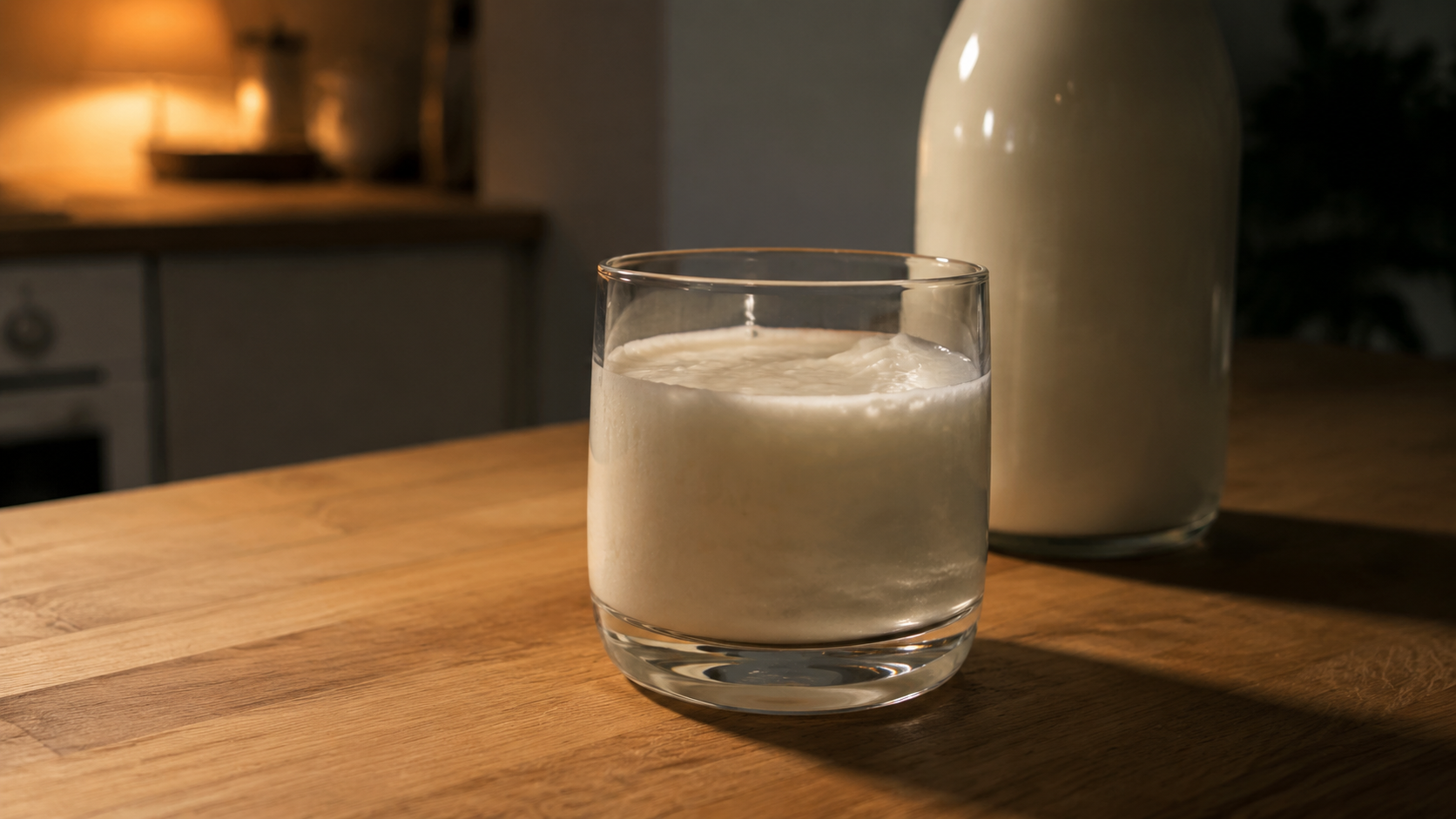
On portion, small genuinely beats large. A few sips of kefir or half a glass of milk is a ritual. A full bowl of cereal or a thick yoghurt with granola is a meal, and your gut treats it accordingly. Most of the complaints I see about dairy before bed describe the second thing, not the first.
There is also the fluid question that nobody mentions. A large glass of anything close to bed means a higher chance of waking up needing the bathroom, and that wake-up gets blamed on the dairy when it was really just the volume.
Where Fermented Dairy Is Different
This is the part that actually applies to me.
I have a few sips of kefir most evenings. Not for sleep originally, just as a habit, and my digestion does seem steadier for it. When I looked into whether that had any grounding, I found something more interesting than the warm milk story.
Fermented dairy contains GABA, produced during fermentation itself rather than present in the original milk. GABA is the main inhibitory neurotransmitter in the brain and the pathway most sleep medications target. Fermented dairy also feeds the gut bacteria involved in the tryptophan to serotonin to melatonin pathway, which is the whole mechanism I went through in the gut health and sleep post.
The lactose content is also substantially lower in kefir than in milk, because the fermentation process consumes much of it. That is likely why people who react badly to milk often tolerate kefir without trouble.
I want to be careful not to overstate this. The direct evidence for kefir improving sleep in humans is thin. What is better supported is the gut side, and the gut connection to sleep is real. My honest read is that the kefir is doing something useful for my digestion, and any sleep benefit is indirect and secondary.
What I Would Actually Do
If you drink warm milk before bed and sleep well, keep doing it. The ritual has value even if the mechanism is not what you were told.
If you sleep badly and have dairy in the evening, it is worth two weeks without it to see what changes. That is a cheap experiment with a clear answer.
If you want the gut benefit without the lactose load, fermented dairy is the more interesting option. Kefir, plain yogurt with live cultures, or a dairy-free fermented alternative if you avoid dairy entirely.
And if none of it makes a difference, the room temperature and your evening light exposure are almost certainly bigger levers than what is in your glass.
Common Questions About Dairy Before Bed
Does warm milk work better than cold?
There is no evidence that temperature changes anything chemically. What warmth does change is the ritual. A warm drink slows you down and takes longer to finish, and that pause is probably where the benefit sits.
Is cheese before bed really the cause of strange dreams?
This one has never held up in testing. What is plausible is that a rich, late, high fat snack disrupts sleep enough to wake you during REM, and dreams you wake up inside are the ones you remember. The cheese gets the blame for the timing.
Is dairy before bed bad for weight or bloating?
For most people a small portion is not an issue. If you bloat overnight after dairy, that points at lactose or a sensitivity rather than the timing, and switching to a fermented option is usually the easier test before cutting it out entirely.
What should I have instead if dairy does not agree with me?
Keep the ritual and change the cup. A caffeine free herbal tea does the same wind-down job, and if you want the fermented angle without the lactose, a small kefir or a plant based fermented drink is worth trying for a couple of weeks.
The Bottom Line
airy before bed is not bad for sleep for most people. It is also not the sleep aid it has been sold as for generations. The tryptophan story does not hold up at the doses regular milk provides, and the reviews that found benefits were largely testing enriched products.
What matters far more is how your own gut handles it, and whether the portion is small enough not to interfere with the cooling and settling your body is trying to do.
Mine is a few sips of kefir. Small, fermented, and mostly about digestion. If there is a sleep benefit from dairy before bed, it is a quiet one.
Have you noticed a difference in your sleep on nights you had dairy in the evening? I would genuinely like to know!



Leave a Reply