
⚕️ Medical Disclosure:
Everything here is based on personal experience and general lifestyle information. None of this is medical advice. If you’re dealing with serious sleep issues, please speak with a doctor — they’re genuinely the right person to speak to.
An evening routine for better sleep sounds like the kind of advice you’d find in a pastel-coloured wellness magazine. I know — I thought the same thing.
For most of my adult life, my “evening routine” looked like this: scroll phone until eyes hurt, put phone down, pick phone back up, check it one more time, put it on the nightstand face-up so the notifications would light up the ceiling, lie there thinking about seventeen things I forgot to do, eventually fall into a shallow sleep somewhere around midnight.
Sound familiar?
The thing that changed wasn’t a product or a supplement or some complicated system. It was something much more boring: I started doing the same small things in the same order every evening. That’s it.
Here’s what my evening routine for better sleep looks like — and why I think it might be worth trying.
Table of Contents
Why I Think Routine Matters More Than Most Sleep Advice
Most sleep advice focuses on the night itself — but an evening routine for better sleep starts before you ever get into bed. Get eight hours. Don’t drink caffeine after 2pm. Sleep in a dark room.
All fine. But none of it helped me much, because my problem wasn’t the sleeping — it was the transition. The getting-there. The gap between a busy, screen-filled evening and actually being ready to rest.
What I’ve found — and what seems to make sense to me intuitively — is that your brain needs a signal. A consistent sequence of “we’re winding down now” cues that it can start to recognize and respond to over time.
Think of it like this: if every night ends the same chaotic way, your brain has no reason to expect sleep is coming. But if every night ends with the same quiet sequence, something shifts. It did for me, anyway.
The Routine: 30 Minutes, Three Phases
I want to be clear: this isn’t a rigid prescription. It’s what works for me. Take what’s useful, leave what isn’t.
Phase 1 — 30 Minutes Before Bed: Change the Environment
Lights down
This is the one I resisted longest because it felt too simple to matter. I was wrong.
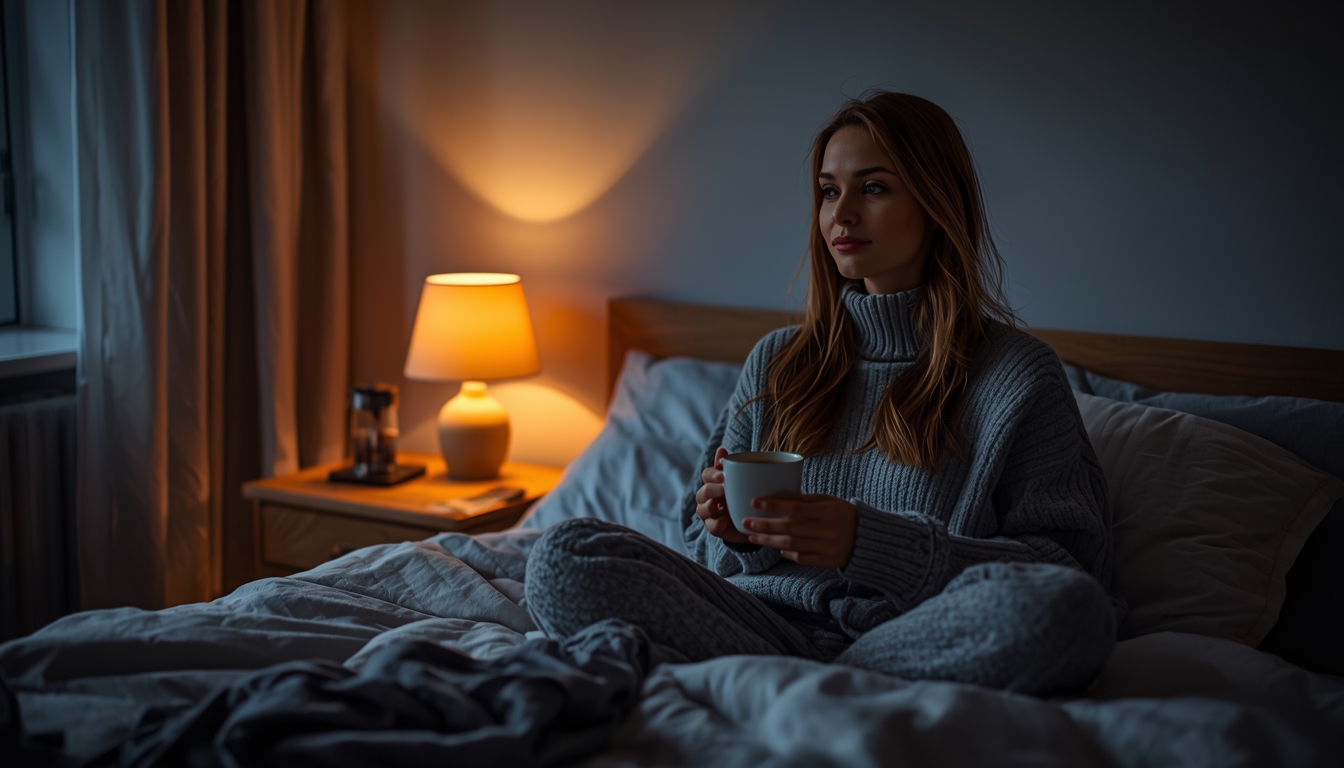
Bright overhead lighting in the evening just doesn’t feel conducive to winding down — and I noticed that on nights I kept it on until the last minute, I felt noticeably more wired when I got into bed. Now I switch to a lamp around 9pm. It takes two seconds and it genuinely changes the atmosphere of the room. If you want ideas on how to set up a sleep-friendly space, I’ve written about cozy bedroom ideas for better sleep that make this step a lot easier.
Cool the room down
I sleep better when it’s slightly cool — not cold, just not warm. (If you often overheat at night, there’s more on that here.) I open the window a crack, or turn the heating down a notch. This took some experimenting to get right, and what works for me might not work for you. But it’s worth playing with.
Phone somewhere less accessible
I charge mine in the living room now. This was the hardest change I made and probably the most impactful. Without the phone next to me, I stopped the reflexive late-night scrolling that was eating 30 minutes of my evenings without me even noticing.
If that feels too extreme, start with face-down on the nightstand with notifications off. The goal is just to make it slightly less automatic to reach for it.

Phase 2 — 20 Minutes Before Bed: Wind Down the Body
Make something warm to drink
I make chamomile or lemon balm tea most nights. I have no idea if the tea itself does anything — honestly, I suspect the ritual matters as much as the contents. Standing in the kitchen, waiting for the kettle, wrapping my hands around a warm mug. It’s a pause. A deliberate slow-down in what might have been a fast day.
If you don’t like herbal tea, warm water with lemon works just as well. The point is the ritual, not the specific drink.
Five minutes of gentle movement
Not exercise. Not yoga. Just — moving slowly and paying attention to my body.
I do a few neck rolls, a gentle forward fold, and then lie on the floor/mat/… for a couple of minutes noticing where I’m holding tension. Some evenings this feels deeply useful. Other evenings I’m just lying on the floor thinking about emails. Both are fine. I do it anyway.
Phase 3 — 10 Minutes Before Bed: Wind Down the Mind
This is the part I was most skeptical about. It’s now the part I’d least want to skip.

Write down:
Tomorrow’s list
Two to three minutes, a notepad, a rough list of whatever is sitting in my head that I don’t want to forget. Tasks, things to follow up on, random thoughts that have been circling.
The act of writing it down seems to genuinely help my brain let go of it. Like it needs permission to stop holding onto things — and the list gives it that permission.
Three things that went okay today
Not three amazing things. Not three things I’m profoundly grateful for. Just three things that went okay. A decent conversation. A task finished. A moment I enjoyed.
Some evenings this takes thirty seconds. Other evenings it takes longer to think of three things — and those are usually the evenings it helps most.
One thing I’m looking forward to tomorrow
One sentence. It can be small. Coffee. A podcast I’ve been saving. A meetup with someone I like. The point is just to close the day with something facing forward rather than something left open.
The Full Routine on One Page
🌙 THE 30-MINUTE EVENING ROUTINE

30 min before bed:
→ Switch to lamp lighting
→ Cool the room slightly
→ Phone less accessible

20 min before bed:
→ Make a warm drink (ritual matters)
→ 5 minutes gentle movement or stretching

10 min before bed:
→ Write tomorrow's to-do list
→ Note 3 things that went okay today
→ One thing to look forward to tomorrow

Then: into bed, lights off.
A Few Honest Caveats
Some nights it doesn’t work.
I still have nights where I lie awake for an hour despite doing everything “right.” The routine isn’t a guarantee. Nothing is. But over time, I have more good nights than bad ones — and I think this is part of why.
It took a few weeks to feel natural.
The first week felt slightly awkward and forced. By week three it felt like just — what I do in the evenings. Give it time before deciding it isn’t working.
You don’t have to do all of it.
If the journaling feels like too much, skip it. If you hate herbal tea, don’t drink it. A shorter version done consistently will serve you better than the full version done occasionally.
The Bottom Line
This evening routine for better sleep isn’t complicated, expensive, or time-consuming.
It’s a lamp instead of overhead lights. A warm drink. Five minutes on the floor. A short list in a notepad.
Small things, done consistently, in the same order. That’s it.
I can’t promise it will work for you the way it has for me — everyone is different, and sleep is genuinely complex. But it costs nothing to try, and the worst case scenario is a slightly calmer evening.
That doesn’t sound so bad.
Tried an evening routine that works for you? I’d genuinely love to hear what’s helped — reach out at driftlyblog@gmail.com


Leave a Reply